


When a patient walks into our clinic with a herniated disc, the first question they usually ask is, "How is decompression actually going to help?" They've read something online, heard it might work, but they don't understand the mechanism. That's a fair question. Modern medicine should make sense to patients, and frankly, if we can't explain why we're recommending a treatment, we shouldn't be recommending it.
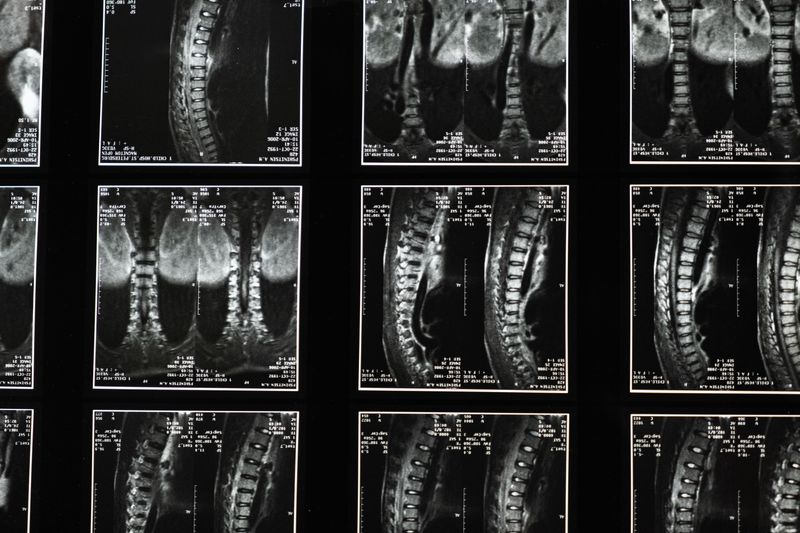
The answer lies in understanding what happens inside the disc itself — specifically, what happens when we create negative intradiscal pressure. This isn't theoretical. This is real physics happening inside your spine right now.
Understanding the Healthy Disc
Your spinal discs aren't what most people think they are. They're not little shock absorbers sitting passively between vertebrae. They're dynamic structures with specific anatomy and a sophisticated job to do.
Each disc has three main components. At the center is the nucleus pulposus — a gel-like substance that's roughly 80% water in a young, healthy disc. This gel is what gives the disc its shock-absorbing capacity. It's held in place by the annulus fibrosus, a tough, fibrous outer wall made of concentric rings of collagen, kind of like a tire. And anchoring both of these to the vertebral bodies above and below are the cartilage endplates.
Here's what's important: that gel center doesn't have its own blood supply. The disc is avascular. It gets its nutrition through a process called imbibition — essentially, it absorbs nutrients and fluid from the vertebral bodies like a sponge absorbs water. When the disc moves through compression and decompression cycles, fluid and nutrients flow in. When it stays static, it dries out.
How Discs Actually Get Injured
Disc herniation doesn't happen because you bent down to pick up a sock. That's what I tell patients when they say, "I didn't do anything — it just happened." You did something. You just didn't do it once.
What actually happens is years of accumulated microtrauma. The nucleus pulposus is under constant pressure — sitting at 25 mmHg at rest, jumping to 175 mmHg when you sit, 100 mmHg when you stand. Add flexion (bending), compression (loading), and rotation together, and you're creating shear forces within the disc. These forces stress the annulus fibrosus, creating small tears in the outer rings. Most of the time, the disc handles this. But over time, with enough repetitions, those microtraumas add up.
Eventually, the nucleus pulposus — that pressurized gel — finds a weak point. It herniates. It pushes through a tear in the annulus and protrudes into the spinal canal. If it touches a nerve root, you get pain, numbness, weakness. If it compresses the spinal cord itself, you get more serious problems.
The Problem With How We Usually Treat This
Here's where I get a little frustrated with conventional approaches. When a patient comes in with a herniated disc, what do they usually get? Rest, NSAIDs, maybe some physical therapy, and if that doesn't work, an MRI, an injection, or referral for surgery.
The problem is none of these things addresses the actual mechanical problem. The herniation is still there. The disc pressure is still high. The nerve root is still compressed. You're managing the symptoms, but you're not fixing the underlying issue.
A cortisone injection reduces inflammation, which can help with pain. That's useful. But the disc hasn't rehydrated. The herniation hasn't retracted. The mechanical compression is still present. So when the injection wears off — and it always does, usually in 3 to 8 weeks — the pain comes back.
What Negative Intradiscal Pressure Actually Does
This is where spinal decompression becomes interesting. During decompression therapy, specifically during the distraction phase, something measurable happens inside the disc: the pressure drops below atmospheric pressure. It goes negative.
Think about what that means physically. Inside the disc, there's normally pressure from the nucleus pulposus pushing outward against the annulus and the surrounding tissues. When we apply the right kind of traction — and this is crucial, it has to be the right kind — that pressure reverses. The pressure inside the disc becomes lower than the pressure outside.
The research is specific on this. Ramos and Martin, in their 1994 studies using VAX-D equipment, measured intradiscal pressures during decompression. They found pressures dropping to -150 to -160 mmHg. To give you perspective, sitting brings intradiscal pressure to roughly 175 mmHg, and standing brings it to about 100 mmHg. So decompression doesn't just reduce the pressure — it reverses it completely.
The Vacuum Effect and Disc Retraction
When you create negative pressure inside the disc, you create what's essentially a vacuum effect. The herniated nuclear material — that gel that's pushed into the spinal canal — experiences a suction force pulling it back toward the center of the disc. This isn't hypothetical. Patients who get MRI imaging before and after a course of decompression often show measurable retraction of the herniation.
This is why the mechanism matters. The herniated material is being mechanically pulled back into the disc, not chemically dissolved or somehow reabsorbed. It's physics.
The other benefit of this negative pressure is enhanced nutrient imbibition. Remember, discs live off the sponge effect. They squeeze, they absorb. Squeeze them too much with pressure, and they can't absorb well. Create a vacuum effect through decompression cycles, and you're actively pulling nutrients and fluid into the disc. The nucleus rehydrates. The disc becomes more resilient.
Why Simple Traction Fails — and Decompression Succeeds
This is a critical distinction that many people misunderstand. Old-school spinal traction — the kind where you lie on a table and a machine pulls on your spine with constant force — often fails. There's a good reason: your body fights back.
The stretch reflex is a protective mechanism. When your muscles sense sustained stretch, they contract. It's automatic. This is why lying on a traction table pulling your spine with 50, 75, even 100 pounds of force doesn't work well. Your paraspinal muscles are actively resisting that pull. You're literally fighting against yourself.
Effective decompression therapy avoids this. VAX-D and similar protocols use logarithmic ramping. The force is applied gradually, incrementally, in a way that bypasses the stretch reflex. Your nervous system never perceives it as a threat to resist. The distraction happens without muscular opposition. The negative pressure builds naturally.
The Cumulative Effect — Why One Session Isn't Enough
I explain this to every patient who asks why we recommend 20 to 28 sessions. Spinal decompression isn't a one-shot treatment. It's a cumulative protocol.
Each decompression session creates negative intradiscal pressure and enhances nutrient imbibition. But the disc needs repeated cycles to rehydrate meaningfully and for the herniation to retract substantially. It's not like an injection where one dose has its peak effect. Decompression is more like physical rehabilitation. Each session builds on the last.
The typical protocol involves sessions spread over several weeks. Frequency matters. Consistency matters. We've found that patients who complete the recommended number of sessions and maintain them consistently — rather than stretching them out sporadically — see significantly better outcomes.
The disc is gradually rehydrating. The nucleus is gradually pulling back. The nerve root pressure is gradually decreasing. Over weeks, these incremental changes become clinically significant. Pain decreases. Function improves. Imaging shows retraction of the herniation.
Clinical Application and Patient Outcomes
In our practice, what we see clinically aligns with what the science predicts. Patients who undergo a proper course of decompression therapy — the right number of sessions at the right frequency — show genuine, measurable improvement. Not all patients. Some discs are too degenerated. Some herniations are too large. Some patients have other pathology we can't address with decompression alone.
But for the right candidate — typically a patient with a contained or subligamentous herniation, without spinal stenosis or significant degeneration — decompression works. The patient's pain decreases. Their imaging improves. They regain function.
This is why understanding the science matters. When you understand that negative intradiscal pressure creates a mechanical retraction of herniated material, that it enhances disc rehydration through imbibition cycles, that it avoids muscular guarding through logarithmic ramping, you understand why the protocol works the way it works. It's not magic. It's physics. It's medicine. And it's backed by the anatomy and physiology of your spine.
Have Questions About Whether Spinal Decompression Is Right for You?
Our team evaluates disc injuries, sciatica, and chronic back pain using a non-surgical, evidence-based approach. Most patients are seen within 48 hours.